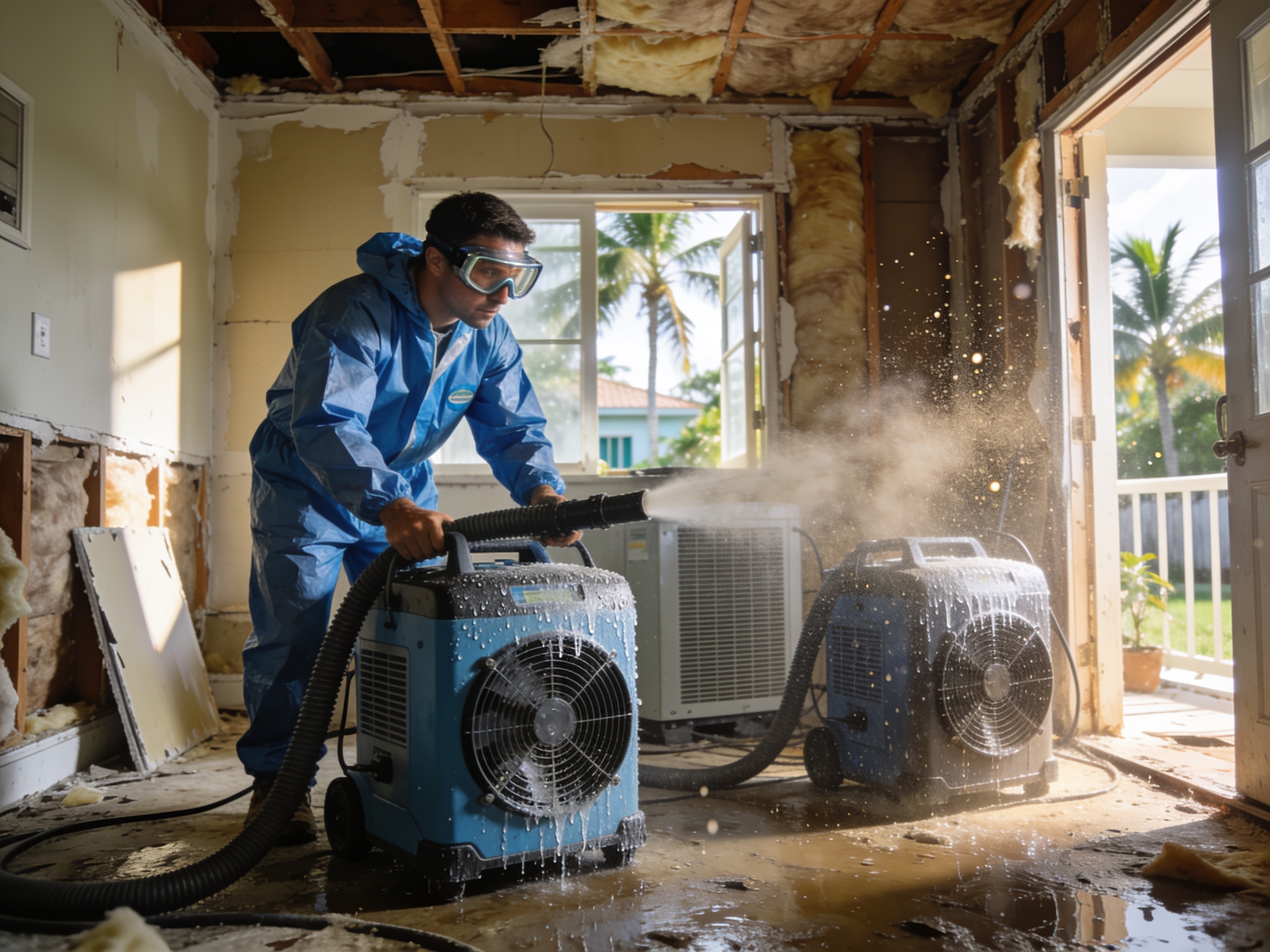
Miami-Dade County’s tropical monsoon climate keeps relative humidity high year-round, so structural drying after leaks or flooding must address both standing water and moisture trapped inside drywall, plaster, and concrete slabs common in Brickell high-rises and older Little Havana single-family homes. Technicians use moisture meters and infrared cameras to locate water that has wicked into baseboards and subfloors, then set up commercial dehumidifiers and air movers sized for the square footage and construction type. Failure to reach manufacturer-specified drying goals can leave hidden pockets that later support mold growth, especially in the Design District’s mixed-use buildings where HVAC systems run constantly.
In neighborhoods such as Coconut Grove and Coral Gables, many homes built before 1970 contain plaster over lath or early drywall that absorbs water differently than modern materials. Drying times extend when summer storms raise groundwater levels near the Miami River and Biscayne Bay, pushing moisture upward through slab foundations. Crews often remove baseboards and drill small vent holes in toe-kicks to allow airflow behind cabinets without full demolition. Daily moisture logs are kept so property owners and adjusters can track progress toward the 1 % per day drying standard used in the industry.
Overtown and Wynwood commercial spaces frequently feature open ceilings and concrete block walls that retain humidity after roof leaks or pipe bursts. Portable desiccant dehumidifiers are brought in when standard refrigerant units cannot pull enough moisture from the air during peak afternoon heat. Technicians also check for trapped water inside elevator shafts and mechanical rooms that serve multiple floors, because residual moisture here can migrate to adjacent units days after the initial event appears resolved.
Technician insight
In Miami the thing that catches most people out with Structural Drying is how quickly the high humidity from our hot wet summers re-saturates walls and slabs if you stop equipment too soon. Older plaster homes in Little Havana and Overtown hold moisture longer than newer builds, so you have to keep monitoring even after surface readings look dry.
Hidden moisture in a Brickell condo after pipe leak
Water from a second-floor unit migrated into the concrete slab and lower walls. Moisture mapping showed elevated readings behind baseboards that standard fans had missed. Desiccant dehumidifiers and wall cavity drying were run for six days until readings stabilized across all affected units.
Structural Drying Services We Offer
✓Moisture Mapping and Documentation
Technicians create room-by-room moisture maps using meters and thermal imaging to identify hidden saturation in walls and floors before drying equipment is placed.
✓Commercial Dehumidification Setup
High-capacity desiccant or LGR dehumidifiers are positioned and monitored daily in Brickell offices and Wynwood warehouses to control humidity levels during extended drying cycles.
✓Slab and Subfloor Drying
Negative-pressure mats and injection drying systems pull moisture from concrete slabs common in Coral Gables and Downtown Miami properties after flooding or plumbing failures.
✓Wall Cavity and Baseboard Drying
Baseboards are removed and air is forced behind drywall or plaster in Little Havana and Overtown homes to dry cavities without unnecessary demolition.
✓Daily Moisture Monitoring
Readings are recorded each visit and shared with property owners so drying progress can be tracked against industry standards before equipment is removed.
Structural Drying Cost in Miami, FL
| Service | Typical Range | What Affects It |
|---|---|---|
| Initial structural drying assessment | $250–$450 | Larger multi-story properties or those with slab involvement cost more. |
| Daily equipment rental and monitoring | $300–$700 | Price rises with number of dehumidifiers and length of run time during summer months. |
| Slab or subfloor drying add-on | $400–$900 | Required when water has wicked into concrete in older Coral Gables or Coconut Grove homes. |
Ranges are typical for Miami, FL and confirmed with an exact written quote before any work starts.
How it works
- 1
Initial Assessment
Technicians inspect affected areas in the Miami-Dade property, measure moisture levels, and note construction details that affect drying strategy.
- 2
Equipment Placement
Dehumidifiers, air movers, and any needed injection systems are set up and adjusted for the specific layout and humidity load.
- 3
Daily Monitoring
Moisture readings are taken each day, equipment is repositioned as needed, and logs are updated until target dryness is reached.
- 4
Final Verification
Final readings confirm all materials meet drying standards; equipment is removed and the space is returned to normal use.
Pricing
Cost depends on square footage, construction type, and how long equipment must run in Miami’s humid conditions.