Miami's older homes in Little Havana and Overtown often have cast iron drain lines that crack or clog from tree roots and shifting soil, sending sewage into crawl spaces and wall cavities during heavy summer rains. Technicians must cut access panels in plaster or tile without compromising the 1920s-1950s framing common in these neighborhoods, then extract standing waste before it migrates into the porous coral rock foundations typical of Miami-Dade County.
The tropical monsoon climate brings daily downpours from May through October that overwhelm municipal lines in Brickell and Downtown Miami high-rises, forcing effluent upward through floor drains. Crews use negative-air machines and HEPA filtration to contain aerosols while removing contaminated carpet pad and subflooring, because the constant 80-plus percent humidity prevents natural drying and accelerates bacterial growth within hours.
Coral Gables and Coconut Grove properties frequently sit on low-lying lots where storm surge or street flooding pushes sewage under slab-on-grade construction. Remediation requires breaking out sections of tile or terrazzo, pressure-washing with EPA-registered disinfectants, and applying antimicrobial coatings that resist the salt-laden moisture unique to coastal Miami-Dade soils.
Wynwood and Design District warehouses converted to living spaces have open ceiling ducts that pull odors and particulates throughout the building after a line failure. Containment barriers and separate air handlers must be set up immediately to protect adjacent units, followed by ozone or hydroxyl treatment once moisture levels drop below 60 percent.
Technician insight
In Miami the thing that catches most people out with Sewage Cleanup is how fast the daily summer rains push street-level backups under 1940s slab homes in Little Havana before owners notice, turning a small overflow into hidden contamination that travels through the coral rock fill under the concrete.
Sewage Backup After Heavy Rain In Wynwood
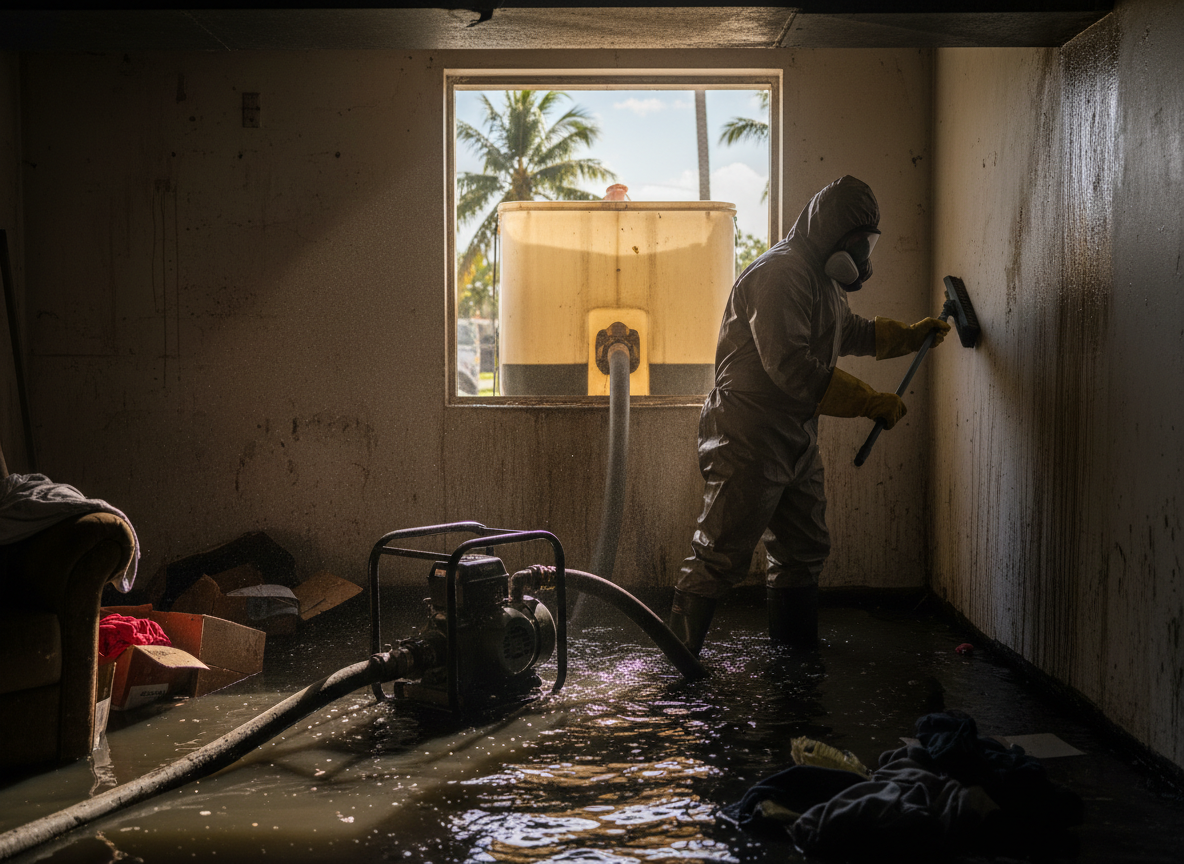
A converted warehouse loft experienced sewage rising through floor drains after a monsoon downpour overwhelmed the combined sewer line. Inspection showed effluent had wicked into the original wood subfloor and reached the base of a load-bearing partition. Crews extracted the waste, removed the contaminated wood, sanitized the slab, and dried the cavities while maintaining negative pressure to protect neighboring units.
Sewage Cleanup Services We Offer
✓Emergency Sewage Extraction
Rapid removal of standing sewage from basements and ground floors in Brickell and Downtown Miami buildings before it reaches electrical systems or spreads through slab cracks.
✓Biohazard Contamination Removal
Safe disposal of Category 3 water materials including carpet, drywall, and insulation from older Little Havana homes where porous lath and plaster retain bacteria.
✓Subfloor and Slab Sanitation
Pressure washing and antimicrobial treatment of concrete slabs in Coral Gables and Coconut Grove properties after sewage migrates under tile or terrazzo finishes.
✓Wall Cavity Drying and Treatment
Targeted drying of plaster and wood framing in Overtown and Wynwood structures using air movers and dehumidifiers sized for Miami's high ambient humidity.
✓Odor Neutralization
Application of enzyme cleaners and hydroxyl generators to eliminate sewage smells trapped in HVAC returns common in multi-unit Design District buildings.
Sewage Cleanup Cost in Miami, FL
| Service | Typical Range | What Affects It |
|---|---|---|
| Initial Assessment And Containment | $150–$350 | Higher in Brickell high-rises due to elevator and parking logistics |
| Sewage Extraction Per 100 Sq Ft | $200–$450 | Varies with standing water depth and debris load |
| Subfloor Sanitation | $300–$700 | Increases for slab homes in Coral Gables with tile removal |
| Wall Cavity Treatment | $250–$600 | Depends on plaster vs drywall and extent of migration |
Ranges are typical for Miami, FL and confirmed with an exact written quote before any work starts.
How it works
- 1
Site Assessment
Inspect affected areas in the specific Miami neighborhood, identify sewage source, and map migration paths through local construction types.
- 2
Containment Setup
Install barriers and negative air to prevent cross-contamination in attached homes typical of Coral Gables and Brickell.
- 3
Extraction And Removal
Pump out liquids and dispose of saturated materials while following Miami-Dade County waste handling rules.
- 4
Cleaning And Sanitizing
Apply EPA disinfectants to all surfaces and treat subfloors for residual bacteria.
- 5
Drying And Verification
Monitor moisture levels until readings match pre-loss conditions in the humid local climate.
Pricing
Upfront quotes provided after on-site inspection; final cost depends on square footage, depth of contamination, and access in multi-story buildings.